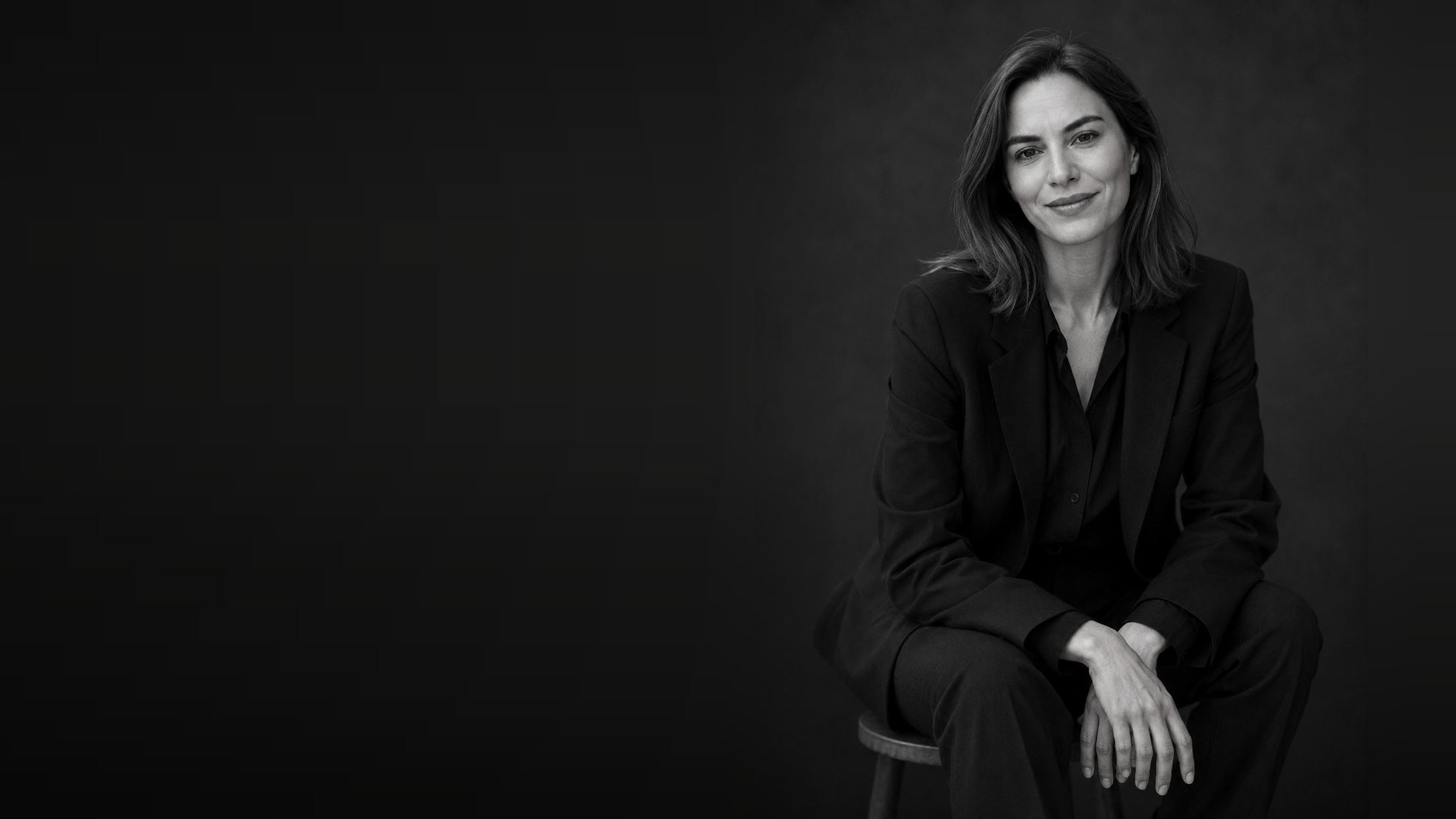
The Founder · Eleni Rizopoulou
From breaking news to breaking silence.
I told other people’s stories for two decades. This is the one I kept off air.
I told other people’s stories for two decades. This is the one I kept off air.
Every night, the worst of the news passed through my voice and came out steady. For years.
The cameras never saw hesitation. The audience never saw uncertainty. I learned to stay calm while the world wasn’t.
I worked as a journalist, anchor and foreign news editor, and led editorial teams across Greek national television, Euronews, NBC, and international organisations.
Different rooms. The same expectation. Read the room. Hold the story. Stay composed.
My job was helping people make sense of the world.
What I never learned was how to make sense of my own.
I grew up in a culture where emotions were inconvenient, vulnerability was weakness, and silence was safety. I translated my emotions.
“I’m drowning” became “I’m fine.” “I’m disappearing” became “I’m tired.” “My nervous system is collapsing” became “I’ll handle it.”
In 2018, the translation stopped working.
One morning I stood in front of my front door and couldn’t open it. Nothing outside that door had changed. Something inside me had.
We call it burnout. It didn’t feel like exhaustion. It felt like I was losing access to myself.
I could read any room.
I could no longer read my own.
What followed was slow. Therapy. Coaching. Writing. Conversations. Time. And the work of learning a language I had reached adulthood without ever being taught: the language of my own signals, first the whispers, then the screams.
The more I learned it, the more I recognised the pattern everywhere. In leaders praised for composure. In organisations where professionalism has become emotional avoidance. In families full of love but short on emotional language. In teams where everyone is communicating and very little is being understood.
Different environments. The same silence.
I wrote to make sense of it. That writing became a newsletter. And the newsletter became Speak the Unspoken.
Everything since has come from one question. How do we build a life, a relationship, an organisation, without the language for what is actually running it?
Today my work brings together emotional development, communication, and leadership. Through keynotes, workshops and writing, I help leaders, teams and organisations read the signals early, before they become conflict, burnout, disengagement, or disconnection.
But silence doesn’t check job titles. This work is for anyone still answering “I’m fine” in a language that stopped being true.
We are living in the age of artificial intelligence with a deficit in emotional language. Intelligence is becoming scalable. Emotional literacy is not. That gap is where this work lives.
I’m not handing people new words for their feelings. Vocabulary is memorised. Fluency is lived.
My vision is one platform that gathers voices and perspectives from more than one field, and gives language to what has stayed unspoken.
I divide my time between France and Greece, but most of my ideas arrive somewhere in between, on a walk by a river, along the coast, through a park, or down an ordinary street.
When I’m home, Ziva, my fourteen-year-old dog, comes with me. She’s heard every unfinished idea before anyone else.
I write constantly, though most of the writing happens on my walks. The keyboard is just where the words agree to stay. Speak the Unspoken began on one of those walks.